Should Low Water Levels in Europe Stop You From Booking a 2027 River Cruise?

Updated: Sep 29
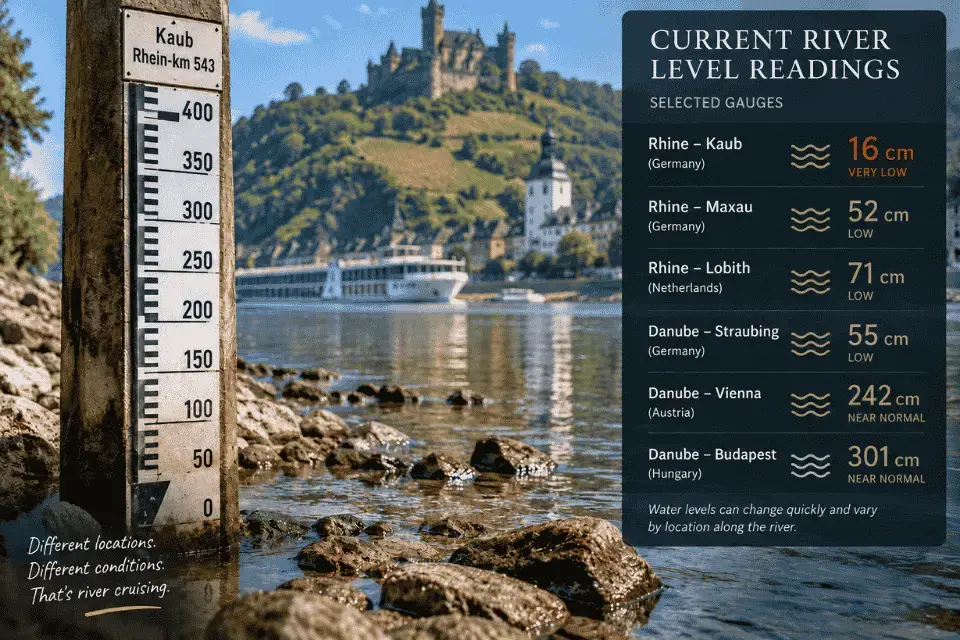
If you've been following the news about European river cruising lately, you may have seen some rather alarming headlines about low water levels on the Rhine and Danube.
And, to be fair, there really is a water-level problem right now.
But if you're considering a European river cruise in 2027, should what's happening today make you reconsider booking?
I don't think it should.
Water levels are one of those realities of river cruising that are worth understanding before you travel. But today's water levels aren't a reliable predictor of what we'll see next spring, summer, or fall. So let's look at what's actually happening and put it into a little perspective.
What's Happening on the Rhine and Danube Right Now?
Europe has experienced an unusually dry and hot 2026, and the effects have been particularly noticeable on parts of the Rhine and Danube.
According to the European Commission's Joint Research Centre, prolonged poor rainfall combined with recurring heatwaves pushed several major European rivers, including the Rhine and Danube, to exceptionally low levels during August.
Conditions remain challenging as we head into late September.
The Rhine
The Rhine is currently experiencing very low water in several important areas.
One of the locations closely watched by river cruise operators is Kaub, in Germany's Middle Rhine Valley. This stretch of river between Rüdesheim and Koblenz is particularly important because it can become a navigation bottleneck when water levels fall.
Earlier this summer, the Rhine reached record-low levels in some locations. Rain toward the end of August brought temporary improvement, but dry conditions caused levels to decline again in September.
For river cruise passengers, that has resulted in changes on some itineraries, including altered docking locations, motorcoach transportation around particularly shallow stretches and, in some cases, ship swaps or cancellations.
The Danube
The Danube has had its own challenges this year. Austria's Federal Ministry for Innovation, Mobility and Infrastructure described water levels during August as exceptionally low, comparable to significant low-water years such as 2003 and 2018. Cruise navigation was significantly restricted in some areas.
Conditions aren't identical along the entire river, however, and that's an important distinction. That's one reason headlines saying "the Danube is too low" can be somewhat misleading. The Danube is more than 1,700 miles long. Conditions in Bavaria can be very different from conditions in Austria, Hungary or Romania.
2026 Has Been an Exceptional Year
There's another important piece of context. This isn't simply a typical river cruise season experiencing a few inconvenient weeks of low water. 2026 has been unusually difficult.
One analysis using approximately 30 years of river data found that, through late September, the Rhine had experienced 134 days below its low-water trouble threshold, compared with the previous high of 91 days in 2022. The Danube had experienced 150 such days, nearly twice the previous high in the dataset.
In other words, if you're watching what's happening this year and thinking, "Wow, this seems pretty bad," you're not wrong. It is. But that's also exactly why I wouldn't use 2026 as the basis for deciding whether to take a river cruise in 2027.
Today's Water Level Tells Us Almost Nothing About Next Year's Cruise Season
River levels aren't like filling a swimming pool. The Rhine isn't going to begin 2027 with whatever water happens to be left over from September.
These are enormous river systems fed by rainfall, tributaries, groundwater and, in some areas, winter snowpack and spring snowmelt. Conditions can change substantially in a matter of days, let alone over six or nine months.
Rainfall during the fall and winter, snow accumulation in the Alps, the timing of spring snowmelt and rainfall throughout the 2027 cruising season will all help determine next year's conditions.
That's why looking at a Rhine water gauge today to decide whether you should book a cruise for June 2027 isn't particularly useful. It's a little like checking today's weather in Budapest to decide whether you'll need an umbrella there next May.
Interesting? Sure. Predictive? Not really.
Could Low Water Levels in Europe Happen Again in 2027?
Absolutely. And this is where I think it's important to be realistic rather than simply reassuring.
Low water has always been a possibility with European river cruising, and travelers should understand that possibility before booking. High water can cause problems, too.
No one can guarantee that a 2027 river cruise won't encounter a water-level issue.
But no one can tell you today that it will, either.
We've seen significant low-water years before, including 2003, 2018 and 2022, and we've also seen years when most cruises operated normally. Even within the same cruising season, conditions can change surprisingly quickly.
That's simply part of traveling on a river rather than an ocean.
What Happens If the Water Is Too Low?
This is another area where experience matters. Cruise lines don't simply wake up one morning, discover the river is low and say, "Well, I guess that's it."
River cruise companies have become quite experienced at dealing with changing water levels.
Depending upon the cruise line, itinerary, ship and location of the problem, they may adjust the sailing schedule, change a docking location, substitute a motorcoach for a portion of the journey, rearrange excursions or move guests between sister ships positioned on opposite sides of an unnavigable stretch.
Viking, for example, says it uses identical sister ships traveling in opposite directions on some itineraries so that a ship swap can be used when necessary. Guests can sometimes transfer to the same stateroom category, or even the corresponding stateroom, on the sister ship.
Other cruise lines have their own contingency plans.
Does that mean the experience is always completely unaffected? No.
Sometimes a port may be missed. You may spend more time on a motorcoach than anticipated. Your embarkation point could change. In more serious situations, portions of an itinerary may need to be substantially altered, and occasionally a sailing can be canceled.
That's worth knowing before you book.
The Cruise Line You Choose Can Matter
This is also one of the reasons I spend so much time talking about finding the right cruise line, rather than simply looking for the lowest price or the prettiest ship.
Different ships have different drafts. Different cruise companies have different fleet sizes, operating strategies and contingency plans. Some have multiple ships operating the same itinerary, potentially giving them more flexibility when a particular stretch of river becomes difficult to navigate.
When comparing cruises, it's perfectly reasonable to ask: What does this cruise line typically do when water levels affect an itinerary?
That's a much more useful question than asking whether the Rhine or Danube will be low eight months from now.
Should You Wait to Book Your 2027 River Cruise?
Personally, I wouldn't postpone booking a 2027 river cruise simply because the Rhine and Danube are low today.
Waiting creates its own set of tradeoffs.
Popular itineraries, departure dates and especially certain stateroom categories can sell out well in advance. Airfare may increase. Promotions may disappear. And after waiting all those months, you'll still have no guarantee what the river will look like when your departure date finally arrives — that is up to Mother Nature!
Instead, I'd focus on the things we actually can control.
Choose the river and itinerary that best fit what you want to experience. Select a cruise line whose style and approach to itinerary disruptions you're comfortable with. Understand the booking and cancellation terms. Consider appropriate travel insurance. And work with someone who understands the ins and outs of river cruising and can help you navigate changes if they occur.
Then stop checking the water gauge every morning. Seriously. It'll drive you crazy.
One Final Thought
I've sailed enough European river cruises to know that they don't always unfold exactly according to the brochure.
Water levels change. Locks occasionally have problems. A port may be substituted. Weather doesn't always cooperate.
But I've also learned that those possibilities shouldn't overshadow what makes river cruising such a wonderful way to experience Europe.
You're traveling directly through the heart of the continent, often docking within walking distance of historic towns and cities, unpacking once while the scenery changes outside your window.
That experience hasn't disappeared because Europe is having an exceptionally dry year.
So if you're considering a river cruise for 2027, I'd certainly pay attention to what's happening in 2026. But I'd just keep it in perspective. Today's river level is today's river level — not next year's forecast.
Frequently Asked Questions About European River Cruise Water Levels
Will the Rhine River be too low for river cruises in 2027?
There's simply no way to know this far in advance. Rhine water levels can change considerably based on rainfall, winter snowpack, spring snowmelt and weather conditions during the cruising season. The unusually low levels experienced in 2026 aren't a reliable predictor of what conditions will be like in 2027.
Will low water affect Danube River cruises in 2027?
It could, but there's no way to predict that today. Low water is always a possibility on the Danube, particularly along shallower stretches of the river. Conditions can also vary considerably from one section of the Danube to another, so a problem in Germany doesn't necessarily mean cruises farther downstream will be affected.
What happens if the Rhine or Danube is too low for my river cruise?
It depends on the cruise line and where the problem occurs. Cruise lines may adjust sailing times, change docking locations, rearrange excursions, use motorcoaches to bypass an affected section of river or, in some cases, transfer passengers to another ship. More significant disruptions can occasionally result in substantial itinerary changes or cancellations.
What time of year has the best water levels for a European river cruise?
Unfortunately, there isn't a guaranteed "best" month. High water is more common during certain periods and low water during others, but weather patterns vary considerably from year to year. Choosing a particular month doesn't eliminate the possibility of a water-related itinerary change.
Should I wait to book a 2027 river cruise because of current low water levels?
Current river levels wouldn't be a particularly useful reason to wait. Conditions today tell us very little about what the Rhine or Danube will look like months from now. Instead, I'd concentrate on choosing the right itinerary and cruise line, and understanding how that cruise line handles unexpected changes when they occur.
Which European rivers are most affected by low water?
The Elbe river in Germany is probably the most prone to low water levels. The Danube and Rhine, while the two most popular sailing options, are also impacted more often than other rivers such as the Seine, Rhone/Saone, and Dutch/Belgian Waterways.
Want to discuss booking your 2027 river cruise with an experienced river cruiser? I'd be happy to assist.
Expert guidance, at no extra cost to you.


Comments